Sure, but there had to be a reason it was seen as a bear rather than, say, a horse. In either case, three stars “following” it could be interpreted in a variety of ways; a tail, three young, hunters, or something else entirely. I’m suggesting the the stars above give the bear a more bearlike than equine appearance and might have been involved originally.
Your point about the Greeks convincing themselves the trailing stars are a tail speaks to the point I was making about the descriptions being passed diwn mostly orally, so there’s no reliable source anymore. Ultimately we’ll probably never know for certain what the first humans to pick out constellations thought they looked like, or exactly how those ideas changed over time, but it is fascinating to think about.
I’m suggesting the the stars above give the bear a more bearlike than equine appearance and might have been involved originally.
And I’m saying you want it to look more like a bear because that’s your idea of it today. It is a bear because it has been a bear for over 10,000 years. The 3 extra stars were not part of the bear itself, but still part of the constellation as a whole, and they were never separated because the dipper shape is recognizable and important. Those other stars you want to add were not part of it - as far as anyone can tell from the surviving versions. It’s not a mistake, it’s not something that was forgotten. Your suggestion is an addition that was never there, because you want to fix it to your modern underestanding of the constellation.


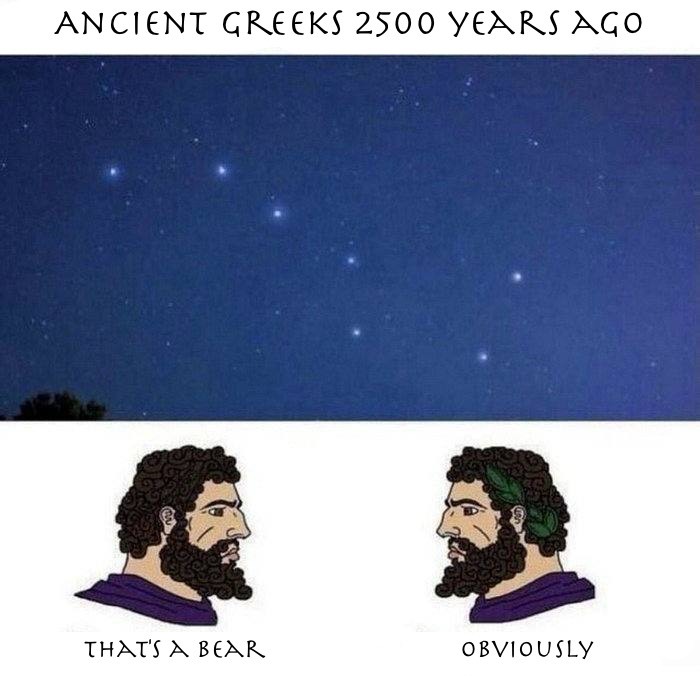
Sure, but there had to be a reason it was seen as a bear rather than, say, a horse. In either case, three stars “following” it could be interpreted in a variety of ways; a tail, three young, hunters, or something else entirely. I’m suggesting the the stars above give the bear a more bearlike than equine appearance and might have been involved originally.
Your point about the Greeks convincing themselves the trailing stars are a tail speaks to the point I was making about the descriptions being passed diwn mostly orally, so there’s no reliable source anymore. Ultimately we’ll probably never know for certain what the first humans to pick out constellations thought they looked like, or exactly how those ideas changed over time, but it is fascinating to think about.
And I’m saying you want it to look more like a bear because that’s your idea of it today. It is a bear because it has been a bear for over 10,000 years. The 3 extra stars were not part of the bear itself, but still part of the constellation as a whole, and they were never separated because the dipper shape is recognizable and important. Those other stars you want to add were not part of it - as far as anyone can tell from the surviving versions. It’s not a mistake, it’s not something that was forgotten. Your suggestion is an addition that was never there, because you want to fix it to your modern underestanding of the constellation.