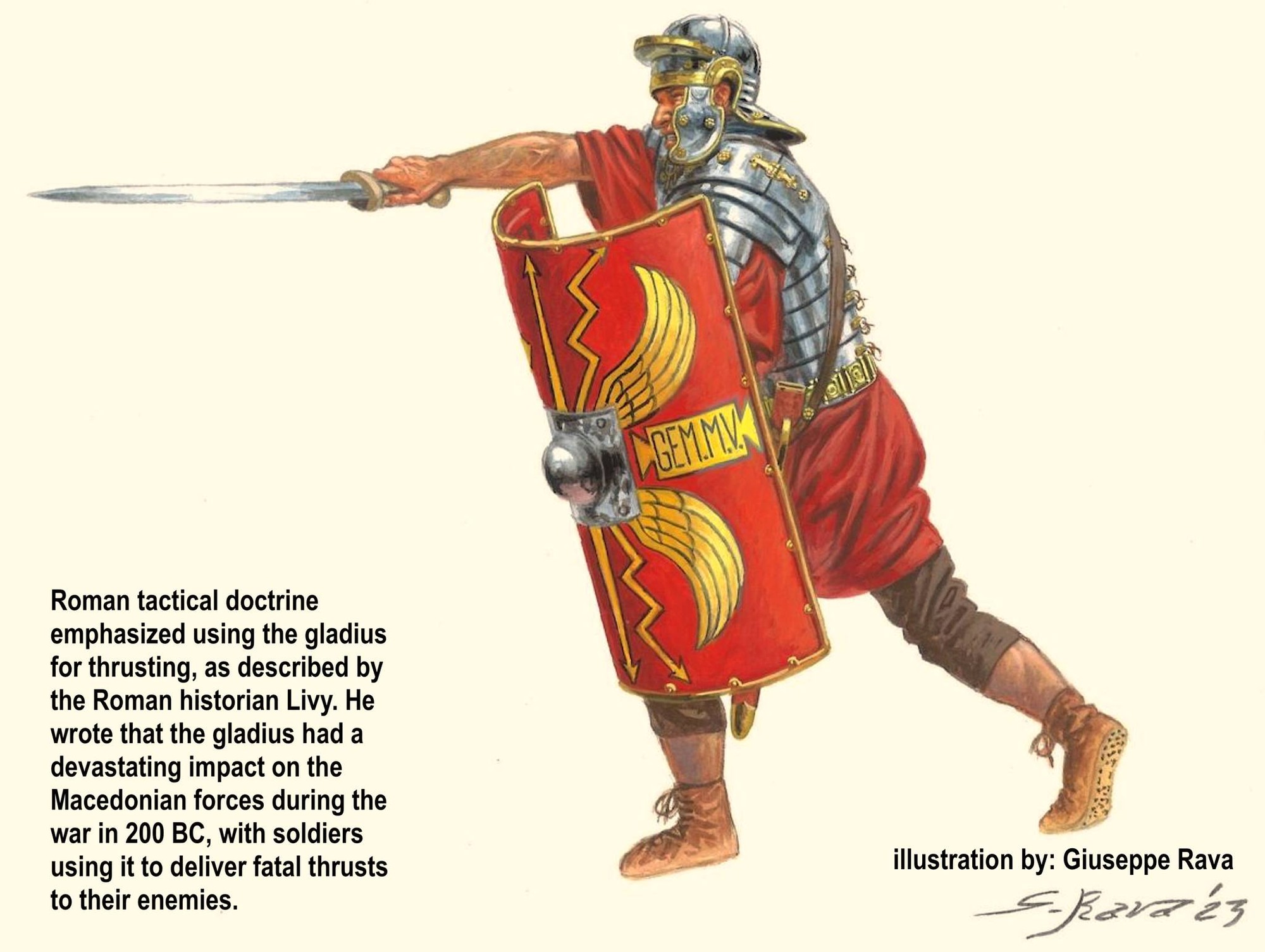
The thrust was used to stabby stab, which is one of the key Gaul weaknesses.
“What are you going to do, stab me?” - Gaul just before being stabbed
There appears (unless there’s something specific here I’m missing, which is very possible - even on Rome, my favorite obsession, what I don’t know fills libraries!) to be a minor mistake in this drawing, funny enough - a legionary’s scabbard in this period should be on his right side. Only officers wore their swords on the left.
While this is unusual in European swordsmanship in general, the Roman Legions of the Mid-Late Republic and Principate era of the Empire preferred it because it kept the shield-hand unimpeded when drawing the sword, especially when in close-order formation. The current two ways of thinking are that it was drawn with a reverse grip, and then shifted to the correct, forward-pointing position (fast, but potential for clumsy fingers is high); or that the scabbard itself was worn somewhat loosely (and the gladius was short enough) so that the scabbard could be pointed forward, and then the blade be pulled out in a ready-to-strike position (useful, but reliant on very good proportions between sword length, belt length, arm length, and, well, soldier length).
2nd-3rd century AD is suggested by the helmet (note the ridge over the forehead - uparmored helmets like that were only popular in the 2nd-3rd century) and wearing of trousers (while trousers were worn on the Germanic frontier as early as the 1st century AD, they didn’t become widespread until the 2nd). The distinctive body armor, the lorica segmentata, was only in use from the 1st-3rd centuries AD, with a smattering of suspected remnants in the 4th century AD.