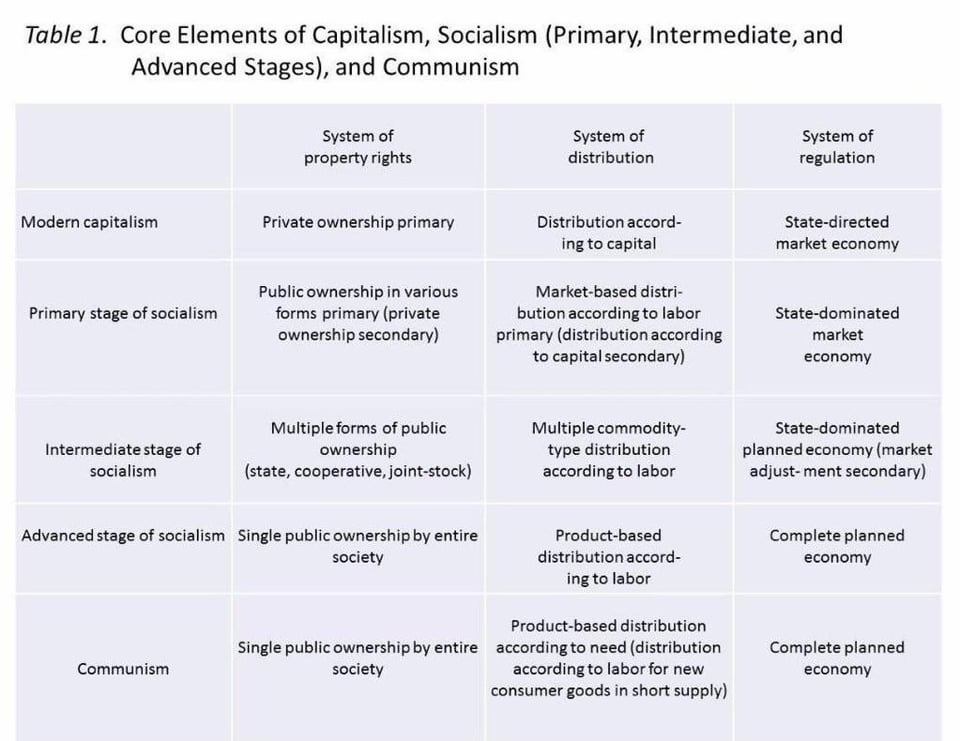
This graph is important
It’s based on the writings of professor Cheng Enfu, President of the Academy of Marxism at the Chinese Academy of Social Sciences (CASS) and Director of the Academic Division of Marxist Studies of CASS.
Socialism and communism are not one and done processes. They are gradual changes, both Marx and Lenin have addressed this extensively. We can’t just instantly press the big communism button unfortunately.
Here’s a paper that goes way more in depth on the professor’s definitions: https://guilfordjournals.com/doi/pdf/10.1521/siso.2022.86.2.159
Communism doesn’t mean a state-planned economy. There is no state under true communism.
Single ownership is centralized communism. Decentralized and multi-centralized communism exists. Correct me if this is a misunderstanding.
deleted by creator
The “boom-bust cycle” instability is inherent to capitalism, not to a socialist economy, planned or otherwise.
https://en.wikipedia.org/wiki/Business_cyclePeriodic crises in capitalism formed the basis of the theory of Karl Marx, who further claimed that these crises were increasing in severity and, on the basis of which, he predicted a communist revolution.
Marxian view, profit is the major engine of the market economy, but business (capital) profitability has a tendency to fall that recurrently creates crises in which mass unemployment occurs, businesses fail, remaining capital is centralized and concentrated and profitability is recovered. In the long run, these crises tend to be more severe and the system will eventually fail.
In contrast, profit is not the engine of a socialist economy: meeting people’s needs is.
deleted by creator
A democratic centralist government is fundamentally different from ‘ceo runs company/state’. And a CEO can’t just do whatever they want: they have to make a profit, or else their investors will have them removed or the company will be liquidated from insolvency.
deleted by creator
Ceos dont have to make a profit. A business needs to make a profit
This is just wordplay. If the business doesn’t make a profit, the CEO gets the boot, so the CEO makes decisions with an eye on profitability.
you fundamentally misunderstand the role of a ceo.
Why don’t you tell us what the role of the CEO is then?
If you have a centralized authority over the economy then you’ll have a monoculture.
By some meanings of “monoculture,” that is definitionally true. But that doesn’t mean the entire country is necessarily run as a monolith, because that centralized “monoculture” may set up any of a variety of power decentralization/federation/power sharing schemes.
The fact is you do not need a centrally planned anything and having one actually prevents improvements.
That’s a very strong assertion of a “fact” without evidence, and frankly sounds like something von Mises or Hayek or Rothbart or Greenspan would say.
deleted by creator
I feel like the big question is who is doing the planning? Because if it’s the central government, not workers themselves, we’re fucked. Communism is bottom-up, not top down. There can be organizers and public servants but there cannot be executives.
deleted by creator
Not every implementation. Maybe every state implementation (widely recognized states tend to be at least somewhat authoritarian, and the existence of a state isn’t compatible with the ultimate goal of a state-less, class-less, & money-less society). But there are some not-as-recognized examples of somewhat successful, somewhat decentralized leftist organizations. (They tend to be in a constant state of war with surrounding right-wing death squads, though.)
To be clear, it makes sense that it’s easier to handle disagreements within an army or party without resorting to outright authoritarianism; people who disagree enough to lead to real conflict are more likely to join a different army/front/party than create chaos inside of it. Still, there might be one last example of a pseudo-state or pseudo-country that seems consistent with anti-authoritarian leftist values:
- (Revolutionary Catalonia)[https://en.wikipedia.org/wiki/Revolutionary_Catalonia]
There was a variety of leftist political activity in the region and no clear leader or authority, at least not in a definite singular sense. Unfortunately, the right-wing nationalist death squad got to them after only about a year. I wish that someone had intervened in nationalist Spain the way there’d been de-Nazi-fication in nationalist Germany.
deleted by creator
i guess that the point i’m trying to make is that communism doesn’t mean central management. in fact, my personal definition of communism, in my mind, or at least to my understanding, contradicts highly authoritarian, centralized, or totalitarian government. you can’t have a classless, stateless society and also a CEO/dictator/president supported by an upper-caste/class of first-class citizens/oligarchs. what i disagree with you on is your conflation of communism with authoritarianism, something i’ve seen both pro- and anti-communists do
don’t let tankies re-define the real meaning of communism, which is worker control, not central control
deleted by creator
Public ownership doesn’t have to mean central ownership. There is such a thing as local government.
Communism isn’t a centrally managed economy. That’s not the definition of communism. The USSR/CCCP never achieved communism, but were stuck at the transitional/intermediate state of socialism. Make of that what you will.