Why? What makes being silent unhealthy? This sounds like you’re imposing your own personal ideas about healthy behavior on everyone. My partner and I frequently don’t speak to each other at all for the day after an intense workweek because we simply need to recover and that’s what works for us. Tis actually the healthiest way for us to connect after a tough day to be in silence together. We’ve been married for over a decade at this point. I have had past relationships where the exact situation in the tweet occurs and it was always devastating to be told I’m “acting different” or that something is wrong with me instead of being asked how I am doing or why I’m being quiet.
And it seems to me that that is also what the tweet is saying. I don’t see any difference between what the tweeter wants and what my spouse and I have.
Edit to add: You came out swinging stating that this tweet is categorically unhealthy, and then arguing your point by reading “silent” as “bad mood” which is not in any way implied by the tweet. All the tweeter wants is a partner whose response to a change in behavior is curiosity/concern/empathy instead of anger/blame.
My husband and I usually tell one another when we’re in a bad mood and why we’re quiet. We then give each other the space or support that the other needs. That’s healthy communication in my experience.
The tweet is putting the burden on the partner to notice the OP’s moodiness and to ask “why” without any input from OP other than acting different.
I added this as an edit to my previous response, but it does directly address your response so I’ll put it here too:
“You came out swinging stating that this tweet is categorically unhealthy, and then arguing your point by reading “silent” as “bad mood” which is not in any way implied by the tweet. All the tweeter wants is a partner whose response to a change in behavior is curiosity/concern/empathy instead of anger/blame.”
It appears to me that the entire conflict in this thread is due to the interpretation of silent as bad mood and asking why as being the point instead of the reaction being the issue.
Edit: Does that seem like an accurate read to you?
I was simply pointing out that stonewalling or giving the silent treatment isn’t healthy either
This is the entire issue though, nowhere in the tweet is stonewalling or giving the silent treatment implied. It simply states that they are silent all day, clearly the wanting to be asked “why” implies a desire for empathy and understanding as opposed to being met with anger and frustration at being quiet.
Thanks for editing after I replied.
I wrote and posted the edit before I saw your reply, and then also replied to your reply. So Idk what you’re on about here.


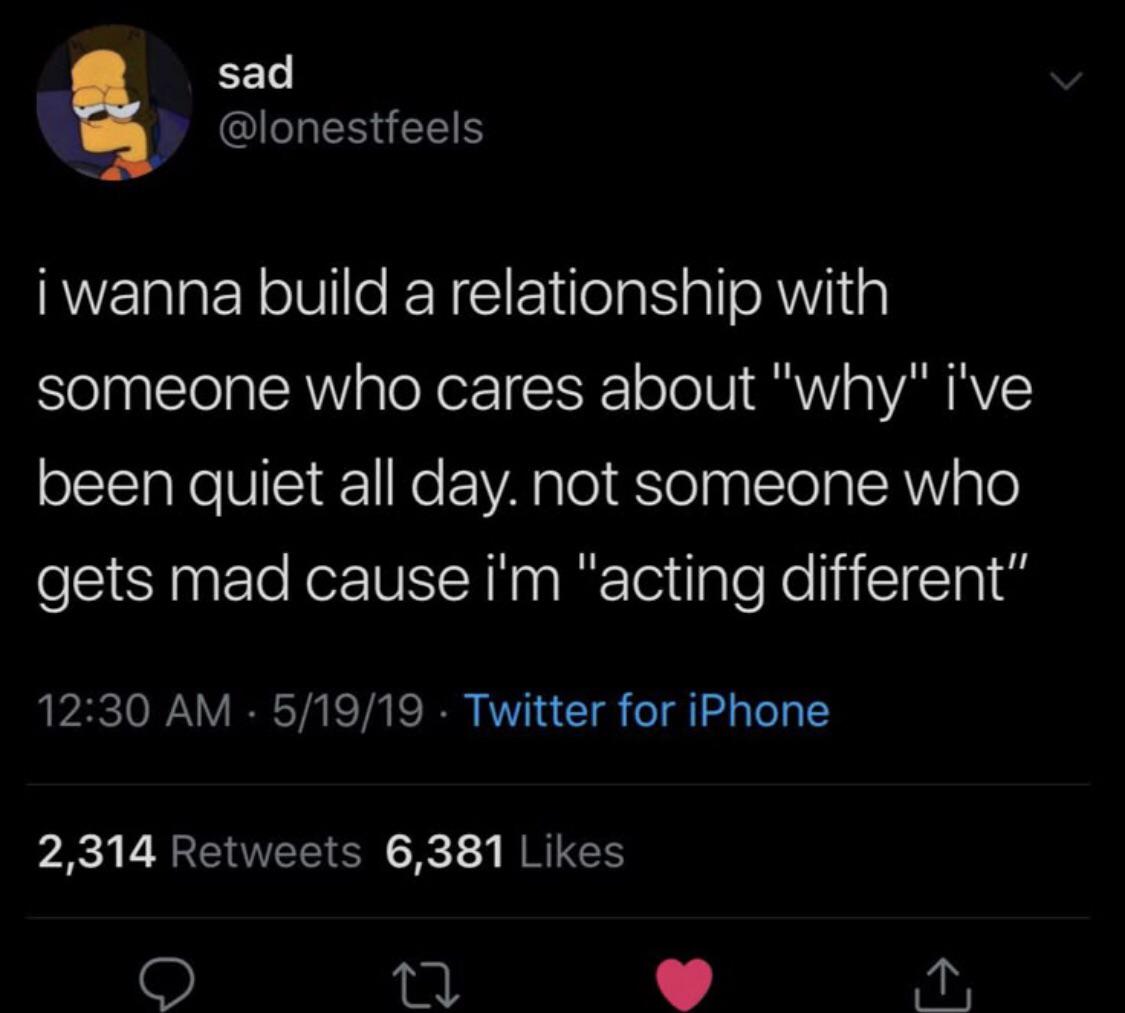
Why? What makes being silent unhealthy? This sounds like you’re imposing your own personal ideas about healthy behavior on everyone. My partner and I frequently don’t speak to each other at all for the day after an intense workweek because we simply need to recover and that’s what works for us. Tis actually the healthiest way for us to connect after a tough day to be in silence together. We’ve been married for over a decade at this point. I have had past relationships where the exact situation in the tweet occurs and it was always devastating to be told I’m “acting different” or that something is wrong with me instead of being asked how I am doing or why I’m being quiet.
But you’re not giving your partner the silent treatment until they notice you’re in a bad mood and ask “why?”
Each couple can have their own things, that’s totally cool and healthy.
It’s the unspoken expectations that I have an issue with.
And it seems to me that that is also what the tweet is saying. I don’t see any difference between what the tweeter wants and what my spouse and I have.
Edit to add: You came out swinging stating that this tweet is categorically unhealthy, and then arguing your point by reading “silent” as “bad mood” which is not in any way implied by the tweet. All the tweeter wants is a partner whose response to a change in behavior is curiosity/concern/empathy instead of anger/blame.
My husband and I usually tell one another when we’re in a bad mood and why we’re quiet. We then give each other the space or support that the other needs. That’s healthy communication in my experience.
The tweet is putting the burden on the partner to notice the OP’s moodiness and to ask “why” without any input from OP other than acting different.
That’s a very healthy behavior for sure.
I added this as an edit to my previous response, but it does directly address your response so I’ll put it here too:
“You came out swinging stating that this tweet is categorically unhealthy, and then arguing your point by reading “silent” as “bad mood” which is not in any way implied by the tweet. All the tweeter wants is a partner whose response to a change in behavior is curiosity/concern/empathy instead of anger/blame.”
It appears to me that the entire conflict in this thread is due to the interpretation of silent as bad mood and asking why as being the point instead of the reaction being the issue.
Edit: Does that seem like an accurate read to you?
Do you not understand what the word “either” was doing in my initial statement?
I was adding to the discussion.
Silence ≠ stonewalling
The “either” in your initial response implies that the silence is the problem, not the response to it.
The silent treatment is a known abuse tactic, so yeah it can be a problem.
Both can be problems.
It can be for sure, but that is not what the tweet is about. You are making a false equivalency, tis that simple.
Thanks for editing after I replied.
I was simply pointing out that stonewalling or giving the silent treatment isn’t healthy either
This is the entire issue though, nowhere in the tweet is stonewalling or giving the silent treatment implied. It simply states that they are silent all day, clearly the wanting to be asked “why” implies a desire for empathy and understanding as opposed to being met with anger and frustration at being quiet.
I wrote and posted the edit before I saw your reply, and then also replied to your reply. So Idk what you’re on about here.