I disagree that your initial response added anything meaningful to the conversation, other than to stoke further discussion, which if that is what you were hoping to accomplish you did so with aplomb. And that’s great, and welcome. My position is that responding to silence (whatever the reason) with violence is abuse. That in no way undermines your point that using silence as a tool for manipulation is also abuse.
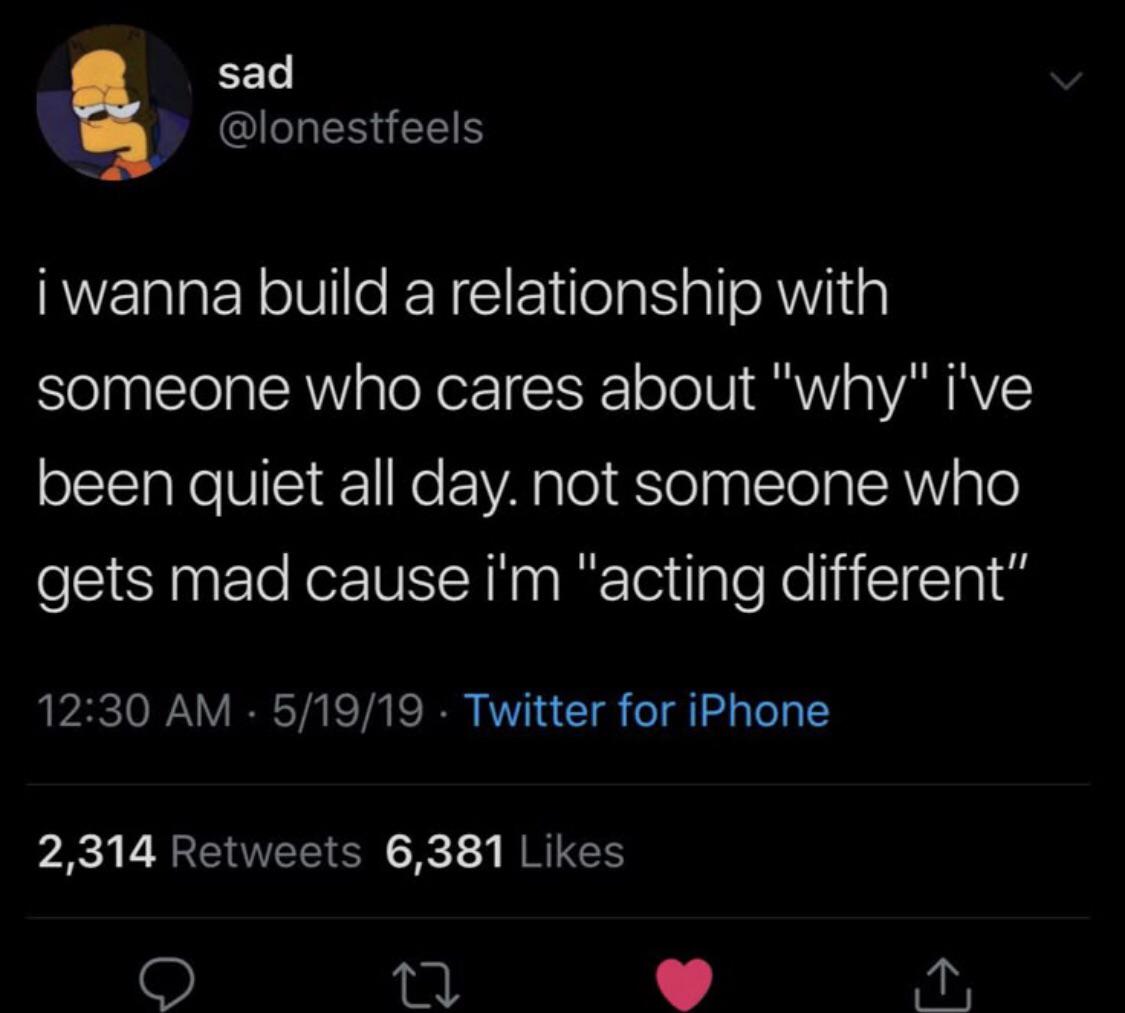
The tweet though simply states a desire for a partner who reacts with empathy instead of anger as something to build towards in partnership, and is actually pretty un-vague about it. That feels pretty healthy and uncontroversial to me personally. Perhaps it is merely a difference of interpretation, but the language of the tweet is pretty cut-and-dry in my opinion.
I appreciate the discussion, and agree with your stance about abuse in relationships, I just disagree that the silence in the tweet is the abuse, and not the anger at it.
Sure, I have trauma from being abused by past partners because I was silent for 30 minutes. My spouse (not wife) does as well. Silence is not inherently abusive, getting mad at someone’s silence in the context of this tweet is absolutely abuse. You are not providing an “other side” to this tweet- you’re inserting your unrelated personal experience into a statement about desired relationship dynamics, which is just a healthy desire for an empathetic partner instead of an abusive one.
Tweet: “I want a partner who treats me with respect and empathy instead of violence when I’m quiet”
You: “Stonewalling is unhealthy too”
That’s false equivalency, and a known abuse tactic.
Replying from a different instance as sh.itjust.works stopped working.
No accusations, simply using the same language you used previously directed at a statement I made.
My personal experience IS actually related to the tweet, whereas yours is related to an assumption made about the tweeter. Not the same thing.
And I wanted to rephrase my statement with regards to trauma: my experience in relationships with NTs (neurotypical) has been one of being told I am mad or upset when I am simply being quiet, in other words they imposed emotions onto me without ever asking why I was silent (oftentimes I merely went nonverbal for a period of time), even after being made aware that that was a normal thing for me. On the flipside, in ND (neurodivergent) relationships I have generally been asked why I am quiet without the assumption of fault by the asker. Perhaps it comes down to that difference. But you are imposing emotion/intent on the tweeter silence, while I am taking the tweet at face value. Now, does that face value happen to reflect my personal experience? Yes. Does that mean I am inserting my unrelated personal experience by including my related person experience? No.
Went back and read through your responses to other folx in this thread, and it’s clear you arguing in bad faith over the assumptions you’ve made about the tweeter and commenters, so I’ll just wish you good day and farewell to you and your husband.


It can be for sure, but that is not what the tweet is about. You are making a false equivalency, tis that simple.
The tweet is vague enough to be open to many different interpretations.
I can just as easily tell you that you’re giving too much grace to OP.
Its meant to spur conversation and that’s been accomplished.
I disagree that your initial response added anything meaningful to the conversation, other than to stoke further discussion, which if that is what you were hoping to accomplish you did so with aplomb. And that’s great, and welcome. My position is that responding to silence (whatever the reason) with violence is abuse. That in no way undermines your point that using silence as a tool for manipulation is also abuse.
The tweet though simply states a desire for a partner who reacts with empathy instead of anger as something to build towards in partnership, and is actually pretty un-vague about it. That feels pretty healthy and uncontroversial to me personally. Perhaps it is merely a difference of interpretation, but the language of the tweet is pretty cut-and-dry in my opinion.
I appreciate the discussion, and agree with your stance about abuse in relationships, I just disagree that the silence in the tweet is the abuse, and not the anger at it.
My initial comment was offering the perspective from the other side.
I’ve had immature partners who fume in silence and resentment because of some unspoken expectation that I had no idea I was failing to meet.
And your personal experience with your wife similarly colors your interpretation of the tweet.
That’s it.
Sure, I have trauma from being abused by past partners because I was silent for 30 minutes. My spouse (not wife) does as well. Silence is not inherently abusive, getting mad at someone’s silence in the context of this tweet is absolutely abuse. You are not providing an “other side” to this tweet- you’re inserting your unrelated personal experience into a statement about desired relationship dynamics, which is just a healthy desire for an empathetic partner instead of an abusive one.
Tweet: “I want a partner who treats me with respect and empathy instead of violence when I’m quiet”
You: “Stonewalling is unhealthy too”
That’s false equivalency, and a known abuse tactic.
You are also inserting your unrelated personal experiences into our conversation about the tweet.
One can desire an empathetic partner and still have unhealthy relationship habits. Feeling anger is not violence.
Now you’re accusing me of using abuse tactics when we’re just having a conversation on the internet, so we’re absolutely done here.
Replying from a different instance as sh.itjust.works stopped working.
No accusations, simply using the same language you used previously directed at a statement I made.
My personal experience IS actually related to the tweet, whereas yours is related to an assumption made about the tweeter. Not the same thing.
And I wanted to rephrase my statement with regards to trauma: my experience in relationships with NTs (neurotypical) has been one of being told I am mad or upset when I am simply being quiet, in other words they imposed emotions onto me without ever asking why I was silent (oftentimes I merely went nonverbal for a period of time), even after being made aware that that was a normal thing for me. On the flipside, in ND (neurodivergent) relationships I have generally been asked why I am quiet without the assumption of fault by the asker. Perhaps it comes down to that difference. But you are imposing emotion/intent on the tweeter silence, while I am taking the tweet at face value. Now, does that face value happen to reflect my personal experience? Yes. Does that mean I am inserting my unrelated personal experience by including my related person experience? No.
I’m not neurotypical myself, but this weird assertion that NT people are abusive because they respond differently than ND people is an odd conclusion.
What? Where do you get that from?
Went back and read through your responses to other folx in this thread, and it’s clear you arguing in bad faith over the assumptions you’ve made about the tweeter and commenters, so I’ll just wish you good day and farewell to you and your husband.